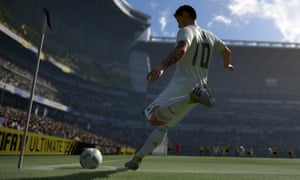
FIFA 17-DEMO!
This, of course, happens every year. The producers at EA Sports in Vancouver have to travel the world evangelising the latest Fifa title to journalists who are used to being told that this is the most exciting, innovative instalment the series has ever seen. And then we’re shown a new heading mechanic.
But this year, there are two genuinely game-changing additions, and a whole host of supplemental tweaks, updates and evolutions. Of course, marketing and sponsorship remain a big part of the pre-release hype, so we know that Fifa 17 will have four ambassadors to help with its authenticity: James Rodriguez, Eden Hazard, Anthony Martial and Marco Reus. Apparently they’re not just faces on the box – they’ve been consulted about new additions to the game. We’ll see.
That’s not the big news, however. Here are the seven key additions to the Fifa squad.
Fifa gets Frostbite

Frostbite is a game engine developed by EA Dice, the studio behind the graphically impressive Battlefield series of first-person shooters. It’s the technology used to build many of EA’s recent and forthcoming releases including Battlefield 1, Mirror’s Edge: Catalyst and Mass Effect: Andromeda – and now it’s powering Fifa.
“We’ve been working on this transition for over two years – it was a massive undertaking,” said the producer, Aaron McHardy, during a recent demo of the game. “It allows authentic, true-to-life action; we’re one step closer to making the game look real. Frostbite comes with a brand new rendering engine and a new toolset, allowing us to really bring the visuals to life.”
The obvious result is more expressive lighting and animation during matches, but that’s not the only upshot of the move. While previous Fifa titles used a specific football simulation engine, Frostbite is a more general purpose tech, meaning that Fifa 17 can move away from the pitch and into completely different locations – just like a first-person shooter or action adventure. Why does it need to do that? Well ...
There’s a new story mode called The Journey

McHardy calls this “the biggest new Fifa mode since Ultimate Team”, and it’s certainly the most intriguing. The Journey is basically a role-playing adventure, set within Fifa, with the player taking on the role of rookie signing Alex Hunter as he starts his career with a club of your choosing. Between matches there are scenes from Hunter’s life, as he fights his way into the first team alongside friend and rival Gareth Walker. At key decision points, you have to guide what Alex does and says – is he going to be a modest team player or a cocky upstart? How will he react when he’s sent out on loan? These choices shape the narrative and affect Turner’s relationships with his manager and squad mates.
Furthermore, everything you do during matches has an effect on the plot. Get sent off and the manager calls you in to his office to explain yourself; score the winning goal in a tense league match and you star in an ego-boosting post-match interview with a television pundit. Throughout the mode, you earn ‘Trait Points’ which can be used to improve Hunter’s attributes in 15 areas such as shooting, passing, defending and dribbling. Also training in specific skills will affect the player’s development.
Apparently, the Fifa development team consulted Dragon Age creator Bioware on the logistics of narrative-based games and also spoke to professional players such as Harry Kane, Dele Alli and Marcus Rashford, to get the feel and content of the story right.
New active intelligence system
EA has improved the positioning technology so AI teammates make better, more incisive runs. A key part of this is that players now have a nuanced understanding of space. Before, they’d just automatically think that gaps nearer the opponent’s goal are the best to run into, and that they should stay away from spaces where teammates are. In Fifa 17, they may put on the brakes to create gaps behindincoming defenders rather than automatically heading forwards; they may also get in close to teammates to pull defenders out of position. “Your teammates are going to work hard,” said McHardy. “They’ll make more runs that are better and more specific to what your side is trying to achieve. There won’t be as many defensive stalemates.” AI players will also make longer runs, even if it means slipping out of position, and they’ll use diagonal runs depending on the incoming passing angle.
In our short hands-on session, AI players definitely looked busier, signalling their intentions and bobbing in and out of the 18-yard box. It was difficult to work out from a few matches, however, if this will result in genuinely useful runs, or if the animation will be obvious enough to flag up more complex intentions.

No comments:
Post a Comment